


An interview with Tristan Colgate (Managing Director) and Anthony Chou (Head of Planning Transformation).
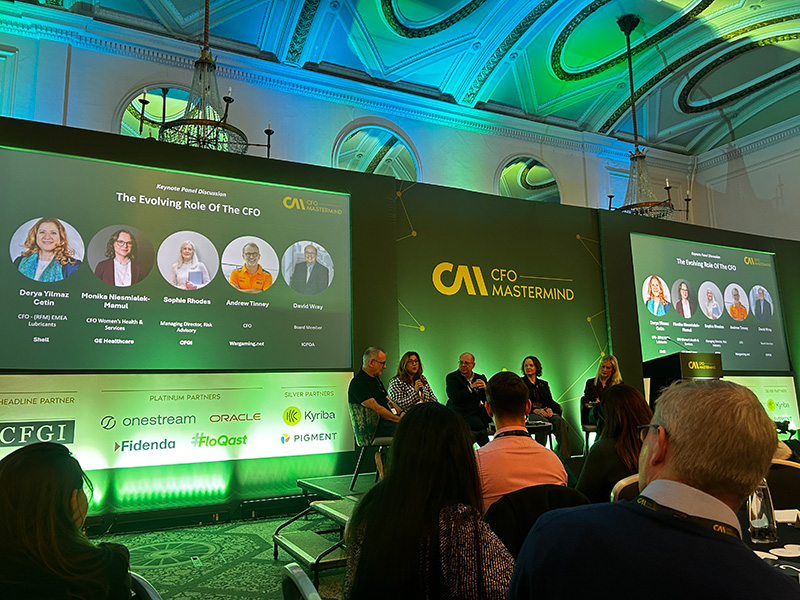
November saw finance leaders from across the UK gather at the De Vere Grand Connaught Rooms in London for the latest CFO Mastermind. It’s a prestigious event and a powerful opportunity to get under the skin of the challenges facing finance teams today. Here at Fidenda, we’re proud to be event sponsors – and in today’s blog Managing Director Tristan Colgate and Head of Planning Transformation Anthony Chou let us in on their key takeaways.
Why is CFO Mastermind such a valuable event to be part of?
Tristan: As a consulting company specialising in technology-led finance transformation, we really value the way CFO Mastermind enables people to share honest insights and experiences. That’s why we chose to be a sponsor – because these events feel different. They’re not about pushing sales, they’re about problem solving together.
Throughout the day, we take part in round-table sessions with small groups of finance people, who take their turn in the hot seat to discuss a challenge they’re facing. It’s such a constructive approach – the whole table helps. Personally I feel I’m able to bring a slightly different viewpoint, coming at each challenge from the intersection of technology and finance, and sharing my experience of transformation.
Anthony: Absolutely. It’s a great opportunity for us to talk to financial leaders, learning more about their roles and challenges in a setting outside the sales cycle. When it’s all about sales, conversations can sometimes feel artificial. In contrast, at CFO Mastermind we always have really honest, interesting conversations. It gives us a way to understand what finance teams are experiencing, so as a business we can give them the best possible support.
What were the key themes of the day?
Tristan: There was a lot of discussion around the finance department’s place within an organisation and how it can find its voice. So we explored how and when finance can challenge the business without stepping on the toes of other functions like marketing. We also looked at the unique skills finance has – and should assert more – and how, as a team, finance can provide a positive, forward-looking narrative rather than being seen as harbingers of bad news.
Anthony: Interestingly for us, there was also a real focus on how to build a business case for improving analytics and reporting and, crucially, how to put a value on better, faster decision-making. We talked about how, in a world of constant change, you can support and build a high-performing team. With finance teams being pulled in multiple directions, it’s more important than ever for them to have the tools, technology and processes to keep their culture and ways of working on track.
Did you find that finance leaders were facing common challenges?
Tristan: Definitely. There was a lot of talk about the transformation of finance – improving what the team is doing, usually through a mix of technology, organisation and process. Finance leaders widely acknowledge what a tough process that is, with no short-cuts to success.
Anthony: People also spoke about the difficulty of navigating challenges and ethical dilemmas while doing the right thing for both the organisation and its people.
Did you hear anything that really surprised you?
Tristan: It was surprising to hear how challenging finance teams are finding communication, persuasion and interpersonal skills. There still seems to be a perception that finance has something to prove in order to earn a seat at the table – tackling that means being more assertive and inserting themselves into every business decision. While CFOs are usually able to do this, aspiring CFOs and wider finance teams aren’t always able to make their voices heard.
Anthony: I agree. I was pleasantly surprised by the acknowledgement that partnerships within organisations need to be nurtured and strengthened, enabling finance teams to contribute better and collaborate directly with the office of the CEO.
What did you learn about how the role of CFO is evolving?
Anthony: This was the focus of the day’s final keynote panel. It was a fascinating session, looking at how the CFO role is changing and what it really means to lead finance today.
Historically, CFOs have held a traditional controller role, with a retrospective focus on ensuring visibility of the numbers. But what the panel emphasised is that today the role is far more multifaceted, combining elements of other roles, including CDO, COO, CIO and strategist.
The decisions CFOs are making are becoming increasingly important and their impact on the organisation is becoming greater. A really interesting example that came up in the panel was an organisation’s decision to close its Russian office ahead of the war in Ukraine.
Because the CFO role is evolving in this way, the panel felt stakeholder management had become a critical part of it, particularly the need to build strong partnerships and think from other people’s perspectives – essential for fostering trust through real understanding.
The final theme to emerge from the session was resilience and the importance of bouncing back stronger. The group used the term ‘anti-fragility’, which I found really interesting – meaning not just recovering, but doing so in a way that makes your organisation stronger.
What’s your perspective on the day’s big topics?
Tristan: Finance can only find its voice and its seat at the table if it shares the analysis and data to support its vital role in decision-making. And to do that, finance teams need the right tools.
The reality is, the world has moved on and simple forecasting no longer gives enough insight to support key decisions. Finance teams need to be able to drive decision-making in meetings by providing immediate analysis of the impact of those decisions.
Fortunately, that’s now possible with the latest technology. But it’s not easy to justify the investment, nor to implement the supporting technology. The problem isn’t a technical one, it’s a conceptual one. Because when you’re asking – how do you create an integrated business plan across an entire business that enables you to accurately analyse the impact of different assumptions? – that’s a conceptual problem. The answer? Start small, start in one business function and branch out.
How does all of this fuel what we do here at Fidenda?
Anthony: The role of finance is increasingly outside finance itself, and that requires a genuinely collaborative approach, sharing data and analysis in a way that empowers the whole organisation. Fidenda’s expertise and capabilities are very much cross functional, so we’re ready to give evolving finance teams – and their colleagues – all the support they need.
Tristan: Finance is, without a doubt, changing. And there’s no getting away from it, not everyone is up for that challenge. We’re talking about the transformation of financial planning and analysis, and it’s not for the faint hearted.
But for those who recognise the advantage integrated business planning brings, and are ready to act on it, the advantages are huge. A louder voice, a bigger influence, a stronger business. Here at Fidenda, we’re actively seeking out finance people who want to take that on.
Interested in bringing IBP into your finance team?
Get in touch to speak with either Tristan or Anthony. And if you’re new to CFO Mastermind, you can find out more about what they do and their next event in summer 2026 at cfomastermind.com