


Explaining our maturity model – and the untold stories behind it
If you’ve been around enterprise technology for a while, you’ll have seen your fair share of so-called maturity models: frameworks that explain business readiness and adoption curves for a new technology. And you might well be a little sceptical of the way they often try to slice complex organisational realities into neat, distinct buckets and chart a clear journey to success. Well, so am I. Yet, at Fidenda, we have one of these models, too.
Anticipate the bumps in the road
So with the caveat that I know that maturity models can be simplistic, and are, by definition, reductive, I’m writing this post to explain our own IBP adoption model. I’m not doing it to give you the impression that if you follow the roadmap, your journey to Integrated Business Planning will be plain sailing. Quite the opposite. I would like to use it to show you some of the bumps and obstacles you’re inevitably going to hit if you’re serious about adopting better planning processes in a complex organisation.
I believe: the sooner we acknowledge that hiccups will happen, the more time and foresight we gain to get ready for them.
That’s the spirit in which I’d like to use the Fidenda maturity model: to illustrate some of the truths about integrated business planning that I, and other Fidenda consultants, see our customers face all the time.
But first, take a look at the model itself. It charts the journey of an organisation that starts out improving planning processes in one department, through to adopting a joint approach for everyone.
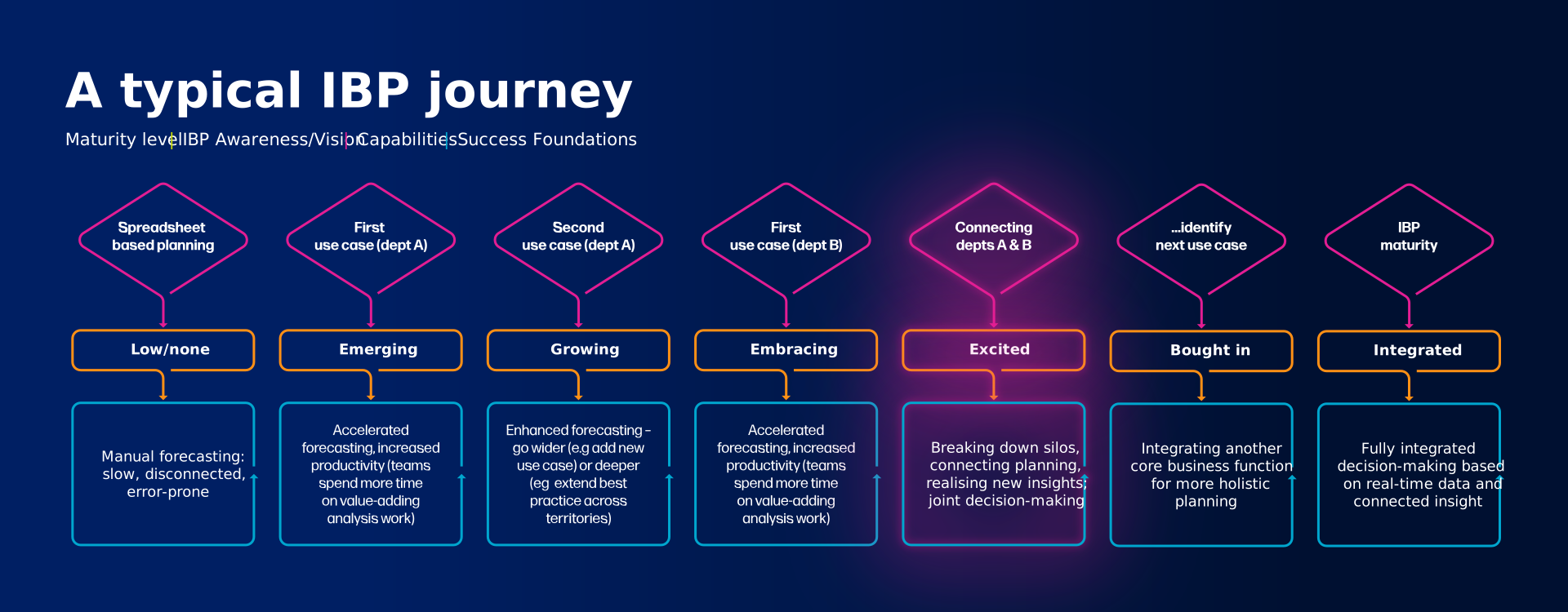
Step 1:
Is the status quo before IBP. It’s your garden-variety, spreadsheet-based planning, where e.g. sales, supply chain, operations, HR and finance teams etc all manage the day-to-day execution of your business in their respective systems – CRM, MRP, HCM and your finance ledger.
A few times a year, there’s a budget process, led by finance: it’s spreadsheet-based and doesn’t drive a joined-up plan for the whole business to get behind. Shortly after it’s been agreed, it’s usually out of date and needs adjusting.
Step 2
A first attempt at improving planning in one department. Let’s say your first use case is in sales (but it could be in any of the departments mentioned above). Let’s say you’re implementing a demand forecasting solution that uses machine learning to predict sales of all your SKUs. It considers your promotional activity and leverages insight from past activities, as well as external factors such as the weather, competitor activity and macroeconomic indicators.
This helps you improve forecast accuracy to over 95% and automates what was previously a manual task for your sales team. They now have more time to spend with their customers, and they’ve improved how they work with the supply team: they can provide them with way more accurate and reliable information.
Step 3
Sales add another use case because they’re turning into believers. They’re extending the demand forecasting solution to predict inventory in your warehouses. This further improves the information they’re able to give to the manufacturing team – and enables you to reduce inventory and the associated costs.
Step 4
Word gets around and another one of your departments is keen to improve planning, let’s say it’s finance. You implement an FP&A solution that replaces your quarterly spreadsheet-based process. By automating the consolidation of actuals, budgets and forecasts from various parts of the business, your team can now move to monthly forecasting. That frees up their time to act as true business partners. Your CFO can now spot upcoming problems faster and guide the management team through overcoming them.
Step 5
This is a big moment: you’re connecting sales and finance. You take sales’ demand forecast and use the detailed data to produce a full commercial forecast reflecting prices and gross sales, trade investments, and cost of goods. This gives you a detailed financial forecast of contribution by product that then becomes the basis for the financial forecast. This drives strategic decision making for the business.
Step 6
You’re identifying the next best use case for your organisation. For instance, you might implement a forecasting solution for your manufacturing facilities. This enables them to plan out their production activities, optimising use of facilities, and understand the costs of raw materials and workforce.
Step 7
The final part of the jigsaw. You’re integrating the manufacturing planning process with both the sales and finance functions’ planning solutions. You implement S&OP processes to take the sales’ team’s demand plan and align it to the production plan to give a consensus forecast. This, along with accurate production cost information is used to produce an accurate forecast of the firm’s financial performance. All parts of the business are running from a common plan, a common set of data, and a joined-up IBP process. The result is that your firm is optimising its return on capital, improving profitability and strengthening the balance sheet.
That all sounds pretty good, doesn’t it?
I think so, too. It’s the vision that IBP as a technology – and a discipline – promises to complex organisations. Done properly, IBP is a true game-changer that delivers significant competitive advantage: it boosts margins and efficiency and helps big, unwieldy organisations sing from the same hymn sheet and pull in the same direction.
IBP needs ‘realistic visionaries’
It’s a vision that’s worth it. But for pretty much everyone right now, it’s still a vision. And if you, like me, have seen a complex organisation or two in the course of your career, you’ll know that the realities of day-to-day operations can stand in the way of realising it. That’s why at Fidenda, we think of ourselves as “realistic visionaries” – consultants who understand the big picture and ultimate goal – but whose day-to-day job entails knowing how to overcome the little obstacles to success that can make your IBP journey grind to a halt. Here are five that we see all the time:
1. For IBP to take off, somebody needs to feel the pain
This is about step one. We still rarely encounter “Heads of Integrated Business Planning” in our practice, or get brought in by a CFO. In fact, few organisations even start out with the goal of integrating planning across departments. This is more likely: one unhappy soul, in one department, realises that things are going awry, and that there should be a better way of doing planning. And if they’re ambitious and tenacious, there’s a good chance they’re the reason their organisation gets to step two. These champions need all the help they can get. (If that person is you, you might enjoy my colleague Anthony Chou’s post “It’s nobody’s job” [LINK]. He’s been there and lived to tell the tale).
2. Increased productivity is great…
It’s a fantastic feeling when you get to relieve a team of the burden of repetitive, manual, spreadsheet-based planning and give them some of their time back to add a completely different kind of value to their organisation. This in itself is worth doing (and I’m immensely grateful that I get to be part of such step two and three projects frequently). But it’s “just” better departmental planning, it’s not integrated business planning yet. And if that’s all you’re after, you might not even need an IBP solution. A dedicated supply chain, sales, or finance tool might do the trick. But it won’t deliver the orchestrated, cross-department planning processes we’re talking about. If your stakeholders don’t understand this, you’ll struggle to get beyond steps three or four.
3. But the real magic happens when you break down silos and connect two departments
You may have noticed that our graphic designer has given step five a little halo effect in the diagram above – and for good reasons: that’s because connecting your first two departments is where the magic happens. We’ve seen this over and over again: the penny drops for decision-makers when you give previously siloed teams a shared tool, language and success metrics to align their planning. It often is THE big revelation that triggers other departments to want to join, and may well get the attention of a C-Level sponsor. It’s really important to celebrate this “silo-breaker moment” in internal comms and get the newly converted to champion IBP further. (I’ve written more about this in my recent blog about silo-breaking [LINK]).
4. Nobody’s there yet
This is the honest truth about step seven that few consultants are willing to admit: we don’t know a single organisation that has reached integrated business planning maturity and aligned all their departments in the same tool, with fully shared processes, a common language and clear roles and responsibilities.
And that’s ok. IBP is still a relatively new, and an evolving discipline. Organisations benefit along the way, even if they haven’t joined up all their data and planning processes yet. If you’re at the beginning of your IBP journey, or considering it, I hope you’ll find this admission encouraging. It’s not too late: you’re in the good company of businesses who are seeing an opportunity to seize a competitive advantage and are still figuring this out.
5. It’s impossible to do this alone
…which brings me to my final point for this blog. If IBP were easy, everybody would be doing it already. But IBP success requires a mix of departmental expertise (eg in FP&A or demand forecasting, or supply chain…), IBP best practice (such as requirements gathering and model building), technical foundations, data readiness, and change management. It’s unlikely for any one champion, or even a group of people in an organisation to have all of these skills inhouse. That’s why we’ve built our service architecture to complement what organisations can do themselves and support them to plug the skills gaps in their IBP journey. That’s what my next blog will be about – I hope you’ll stay tuned.
We’re better in person
As Anaplan consultants, we’re not saying the journey to IBP is easy, but we know it’s worth it, and we can support you along the way. If you’re considering Anaplan but are unsure where to start, we’d love to help.